Temperature taking
Learn how to correctly take your child's temperature when they have a fever.
Key points
- Use a thermometer to measure your child's body temperature and find out if they have a fever.
- The best way to take a temperature depends on a child’s age.
- Always wash thermometers before and after taking a temperature.
- See your child's health-care provider if your child's fever lasts for five days or if your child has a fever and is less than three months old.
Children often feel warm to the touch when they have a fever, but putting your hand to your child's forehead is not enough to find out if your child has a fever. To confirm that your child has a fever, use a thermometer to measure your child's body temperature.
A temperature of 38°C (100.4°F) or higher is a fever
Converting Fahrenheit (°F) and Celsius (°C)
Temperatures are measured in degrees Celsius (°C) or degrees Fahrenheit (°F). The table below shows equivalent Celsius and Fahrenheit temperatures.

| 37°C | 98.6°F |
| 37.2°C | 99°F |
| 37.5°C | 99.5°F |
| 37.8°C | 100°F |
| 38°C | 100.4°F |
| 38.3°C | 101°F |
| 38.9°C | 102°F |
| 39.5°C | 103°F |
| 40°C | 104°F |
| 40.6°C | 105°F |
| 41.1°C | 106°F |
| 41.7°C | 107°F |
Use a thermometer to measure body temperature
The easiest way to measure your child’s temperature is with a digital thermometer. These are available at most pharmacies.
Four places to take a child’s temperature
- in the mouth
- in the anus (or rectum)
- under the armpit
- in the ear
Do not use a rectal thermometer in the mouth or an oral thermometer in the rectum. Always wash any thermometer with soap and warm water before and after use.
The best way to take a temperature depends on your child’s age

| Age | Where to take the temperature | |
|---|---|---|
| Recommended | Alternative method | |
| Newborns to 2 years | Rectal temperature (anus) | Axillary temperature (armpit) |
| 2–5 years | Axillary or ear temperature | Axillary or ear temperature |
| Children over 5 years | Oral temperature (mouth) | Axillary or ear temperature |
Temperature checking methods to avoid
Digital electronic pacifier thermometers and thermometer strips (which measure temperature on the forehead) are inaccurate and unreliable. Do not use these methods to take your child's temperature.
Touching your child's forehead or neck may give you a hint that your child has a fever, but this is not a reliable way to check for fever. Confirm your suspicion of a fever by taking a true measurement using the methods explained below.
Glass thermometers that contain mercury should be avoided because mercury is toxic. If you only have access to a glass thermometer, take very special care. If the thermometer is cracked or damaged in any way, do not use it. Even an undamaged glass thermometer can be a risk for your child. If you believe your child may bite down on the thermometer, do not use it to take a temperature in the mouth.
Non-contact infrared thermometers and temporal artery thermometers are not recommended. While convenient, these methods are more costly, and temperature readings may be inaccurate because they can be affected by skin tone, sweat, cold temperatures, direct sunlight, technique, positioning and humidity.
How to take an oral temperature (in the mouth)
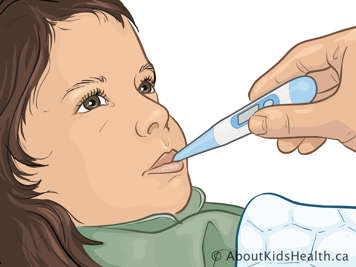
Taking a temperature in the mouth works with children who are old enough to hold the thermometer under their tongue and who will not bite the thermometer. A mouth thermometer is the most accurate way of measuring the temperature of an older child. Make sure your child has not had cold or hot drinks in the 30 minutes before taking their temperature.
- To get an accurate reading, carefully place the tip of the thermometer under your child’s tongue.
- Ask your child to keep the thermometer in place by forming a seal with their lips. Make sure they do not bite down on the thermometer. If they cannot breathe through their nose, use one of the other methods to measure their temperature.
- If you are using a digital thermometer, leave it in the mouth until you hear it beep.
- Carefully read the temperature on the thermometer.
- Turn off the digital thermometer, wash the tip with soap and warm (not hot) water, and wipe it off with alcohol. Dry well.
How to take a rectal temperature (in the anus)
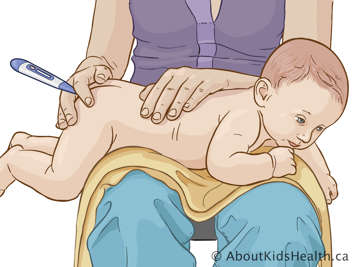
Using the rectal method works best on babies and young children. Older children may resist having something put in their bum.
- Before taking your child’s temperature, make sure they are relaxed. Place your child on their stomach on a comfortable surface if they can hold their head and do tummy time. Place your child on their back if they are still unable to safely lie on their stomach.
- Before inserting the thermometer, make sure it is clean. Coat the end of it with petroleum jelly (Vaseline). This will make the insertion easier.
- Insert the thermometer gently into your child’s rectum about 2 cm (1 inch). If there is any resistance, pull the thermometer back a little. Never try to force the thermometer past any resistance. This avoids injury to your child.
- Hold your child still while the thermometer is in.
- If you are using a digital thermometer, take it out when you hear the signal (usually a beep or a series of beeps).
- Read the temperature.
- Turn off the digital thermometer, wash the tip with soap and warm (not hot) water. Dry well.
How to take an armpit (axillary) temperature
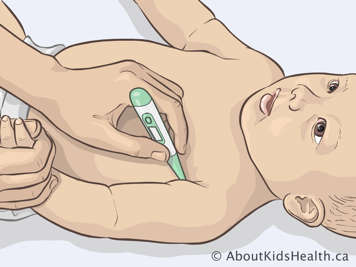
Taking the temperature under the armpit may be less accurate than in the rectum or the mouth but easier in some babies or children. To take a temperature in the armpit, your child must be able to hold their arm to the body and not move it for as long as it takes the thermometer to finish measuring.
- If you are using a digital thermometer, turn it on.
- Put the thermometer under your child’s dry armpit. The silver tip must touch the skin.
- Hold the top of the thermometer with one hand and hold down your child’s arm with the other hand.
- If using a digital thermometer, wait until you hear the signal (usually a beep or a series of beeps).
- Turn off the thermometer, wash the tip with soap and warm (not hot) water. Dry well.
How to take an ear (tympanic) temperature
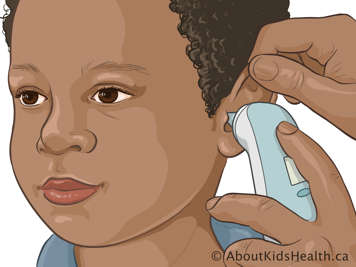
Tympanic thermometers may be less accurate than oral or rectal thermometers. Tympanic thermometers are unsuitable for children under two years of age because their ear canal may be too small to allow for an accurate temperature reading. Always clean the thermometer tip before use and follow the manufacturer’s instructions carefully.
- Gently tug on the ear, pulling it up and back. This will help straighten the ear canal and make a clear path inside the ear to the eardrum.
- Gently insert the thermometer until the ear canal is fully sealed off.
- Squeeze and hold down the button for one second.
- Remove the thermometer and read the temperature.
When to see a health-care provider
See your child's regular health-care provider or go to the nearest Emergency Department if your child has a fever and:
- Your child is less than three months old.
- You have recently returned from travelling abroad.
- Your
child develops a rash that looks like small purple dots that do not go
away when you apply pressure with your fingers (blanching).
- Your child is not able to keep down any fluids, is not peeing and appears dehydrated.
- Your child's skin looks very pale or grey or is cool or mottled.
- Your child is in constant pain.
- Your child is lethargic (very weak) or difficult to wake up.
- Your child has a stiff neck.
- Your child has a seizure associated with fever for the first time or a long seizure associated with fever.
- Your child seems confused or is showing changes in behaviour.
- Your child does not use their arm or leg normally or refuses to stand up.
- Your child has problems breathing.
- Your child cries constantly and cannot be settled.
See a health-care provider within 24 hours if your child has a fever and:
- Your child is between three and six months old.
- Your child has specific pain, such as ear or throat pain that may require evaluation.
- Your child has had a fever for more than three days.
- The fever went away for over 24 hours and then came back.
- Your child has a bacterial infection that is being treated with an antibiotic, but the fever is not going away after two to three days of starting the antibiotic.
- Your child cries or has pain when peeing.
- You have other concerns or questions.
If you need advice about your child's health, Telehealth can be accessed from anywhere in Canada by calling 811.
Your child may show physical changes when their condition is serious or when their condition gets worse. Parents and caregivers can learn how to spot these signs in order to seek help from a health-care provider.

Δεν υπάρχουν σχόλια:
Δημοσίευση σχολίου