NAPFA: Ένα πολυμεταβλητό μοντέλο για την πρόβλεψη της τροφικής αλλεργίας στα παιδιά
Η τροφική αλλεργία (FA) είναι μια από τις πιο συχνές χρόνιες παθήσεις στα παιδιά. Οι διαγνωστικές καθυστερήσεις και τα σφάλματα στην τροφική αλλεργία αποτελούν σχετικά προβλήματα στην κλινική πράξη. .
Η βαθμολογία NAPFA θα μπορούσε να είναι ένα εύχρηστο εργαλείο που έχει τη δυνατότητα να βελτιστοποιήσει τη διαγνωστική διαδικασία γαι την τροφική αλλεργία στην παιδική ηλικία, μειώνοντας τις περιττές εξετάσεις και βελτιώνοντας τα αποτελέσματα των ασθενών σε μια ποικιλία περιβαλλόντων υγειονομικής περίθαλψης
A Turbuhaler delivers asthma medicine in powder form. Learn how to properly use a Turbuhaler.
Key points
The Turbuhaler inhaler dispenses medicine in a powder that is breathed into the lungs.
Turbuhaler
inhalers are appropriate for older children and teens who can
effectively form a seal with their lips and follow specific medication
instructions.
Introduction
Turbuhaler
What is a Turbuhaler?
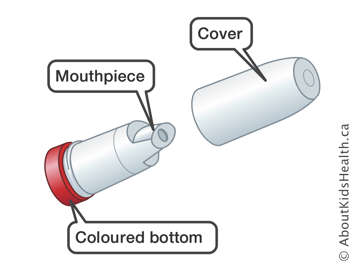
A Turbuhaler is a white cylinder
with a coloured base. It is used to deliver medicines in powder form. It
has a dose counter window so you can see how many doses are left. To
use a Turbuhaler, your child must be able to form a seal around the
inhaler with their lips, and breath fast and deep enough to effectively
get the medication into their lungs.
Helping your child
How to use the Turbuhaler
Your child can watch the video or follow the illustrated steps below when taking medicine with a Turbuhaler.
How to use your Turbuhaler
Step 1: Open the Turbuhaler
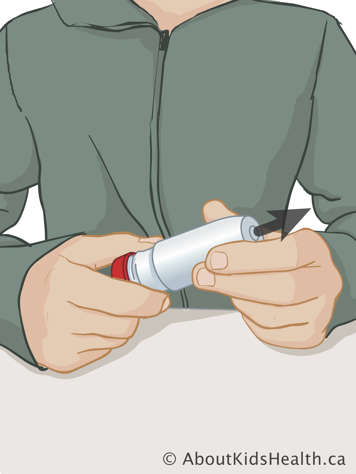
Unscrew the white cover and take it off the Turbuhaler.
Step 2: Get the medicine ready
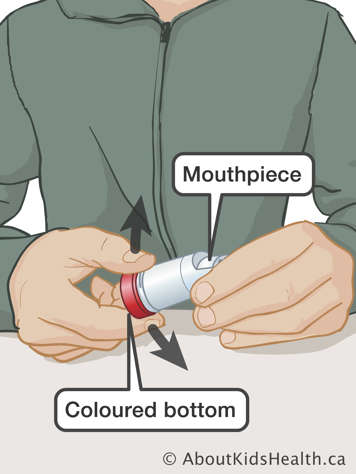
Hold the Turbuhaler with the mouthpiece pointing up.
Hold the Turbuhaler in one hand and twist the coloured bottom of the
Turbuhaler with the other hand. Twist it as far to the right as it will
go, then twist to the left until you hear a click. The click means that
the medicine is ready.
To prevent the loaded dose from getting lost, do not drop or bang the Turbuhaler.
Step 3: Take the medicine
Stand or sit up straight.
Breathe out.
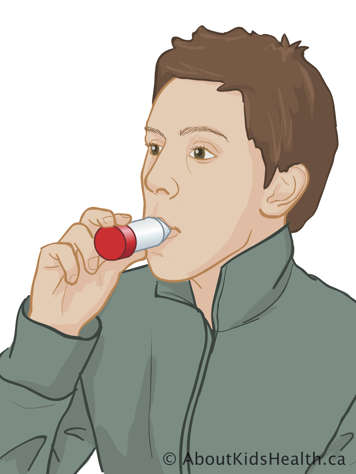
Put the mouthpiece between your teeth, then wrap your lips around the mouthpiece tightly so that no air can get out.
Tilt your head back a little bit.
Breathe in as fast and as deeply as you can.
Take the Turbuhaler out of your mouth.
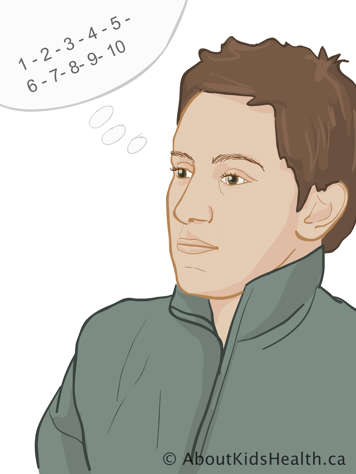
Hold your breath while you count to 10 slowly.
Breathe out slowly from your mouth.
Repeat Steps 2 to 3 if you need to take additional doses.
Step 4: Close the Turbuhaler
Screw the white cover back on to the Turbuhaler.
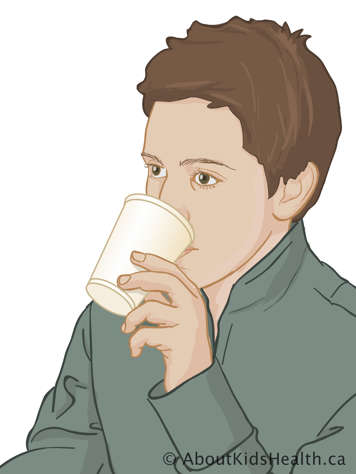
Rinse your mouth with water or drink something afterwards.
How do you know how much medicine is left in your child’s Turbuhaler?
Some Turbuhalers have a red mark, which appears in a window on the
side of the device when there are 20 doses left. Other Turbuhalers have a
dose counter that counts backwards with each dose. Remember that you
cannot tell if the inhaler is empty by feel or sound alone.
How to clean your Turbuhaler
Wipe off the mouthpiece with a dry tissue after use.
Never use any liquid to clean the Turbuhaler.
If powder sticks in the hole, try to brush it out.
A Diskus inhaler delivers asthma medicine in powder form. Learn how to properly use a Diskus inhaler.
Key points
A Diskus inhaler dispenses asthma medicine in a powder that is breathed into the lungs.
The
Diskus is appropriate for older children and teens who can effectively
form a seal with their lips and follow specific medication instructions.
Introduction
Diskus inhaler
What is a Diskus inhaler?
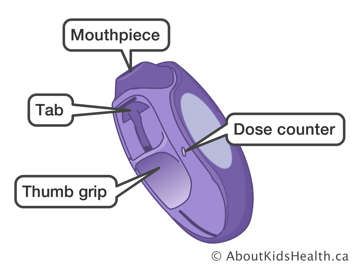
A Diskus inhaler is a flat, round
device that is used to deliver asthma medicines in powder form. It has a
dose counter window so you can see how many doses are left. Diskus
inhalers are used for older children and teenagers. To use a Diskus,
your child must be able to form a seal around the inhaler with their
lips, and breath fast and deep enough to effectively get the medication
into their lungs.
Helping your child
How to use a Diskus inhaler
Your child can watch the video or follow the illustrated steps below when taking medicine with a Diskus inhaler.
How to take the Diskus inhaler
Step 1: Open the Diskus
Hold the Diskus inhaler in one hand.
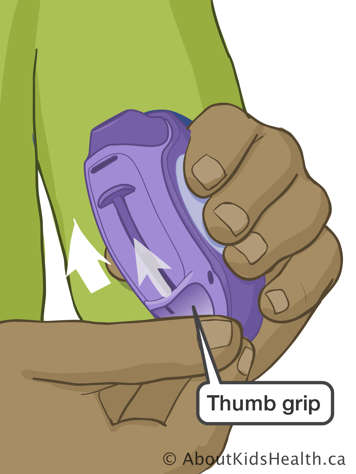
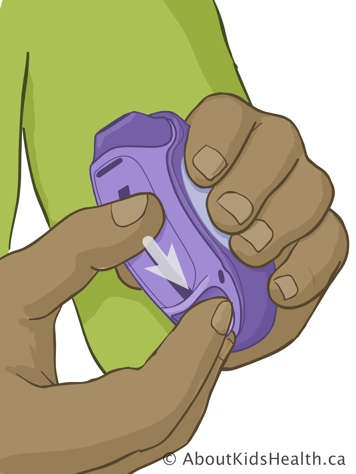
Put the thumb of your other hand into the thumb grip, which is a hollow spot that fits your thumb tightly.
Push your thumb away from you until you hear a click. You should be able to see the mouthpiece and the tab beside it.
Step 2: Get the medicine ready
Hold the Diskus inhaler in one hand.
With your other hand, put your first finger in the thumb grip and the thumb on the tab.
Slide the tab away from you, toward your first finger, until you hear a click. This means the medicine is ready.
To prevent the loaded dose from getting lost, do not drop or bang the Diskus inhaler.
Step 3: Take the medicine
Breathe out.
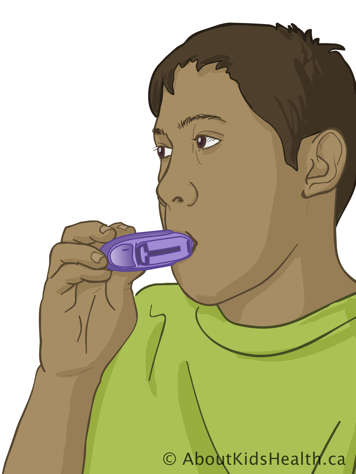
Wrap your lips tightly around the mouthpiece of the Diskus inhaler.
Breathe in quickly and deeply.
Take the Diskus inhaler out of your mouth.
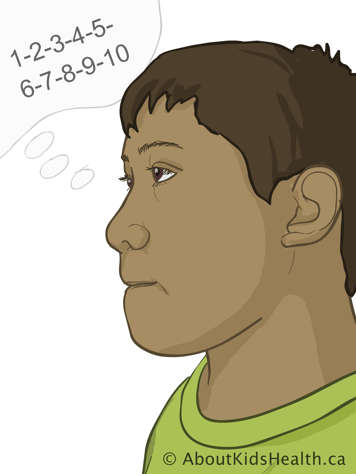
Hold your breath while you count to 10 slowly.
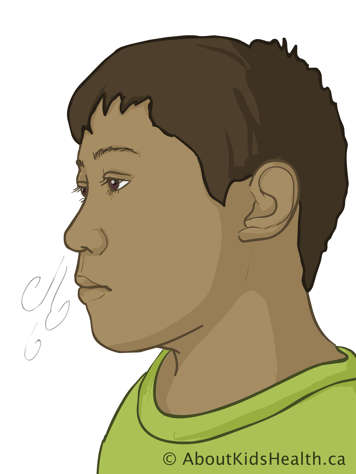
Breathe out slowly through your nose.
Repeat steps 2 to 3 if you need to take additional doses.
Step 4: Close the Diskus
Close the Diskus inhaler by holding it in one hand.
With the other hand, put the thumb back into the thumb grip.
Slide the thumb grip toward you until you hear a click.
The Diskus inhaler is now ready for the next time you need to take your medicine for asthma.
Keep the Diskus inhaler in a dry storage area at room temperature.
How do you know how much medicine is left in your child’s Diskus inhaler?
Always check how much medicine is left in the Diskus by looking at
the dose counter at the side of the Diskus inhaler. Each time a dose of
medicine is taken, the counter will count backwards by one dose.
Η χρήση εισπνεόμενων φαρμάκων είναι αρκετά διαδεδομένη στα παιδιά. Τα εισπνεόμενα φάρμακα είναι πολύ χρήσιμα, καθώς το φάρμακο μεταφέρεται απευθείας στους πνεύμονες όπου χρειάζεται και λιγότερο στους υπόλοιπους ιστούς, με αποτέλεσμα λιγότερες συστηματικές παρενέργειες.
Η σωστή χρήση τους όμως είναι πολύ σημαντική για την αποτελεσματική χρήση του φαρμάκου.
Για την χορήγηση τους χρησιμοποιούνται διάφορες συσκευές
Οι συσκευές που
χρησιμοποιούνται για τη χορήγηση εισπνεόμενων φαρμάκων είναι:
Δοσιμετρικές
συσκευές αερολυμάτων (pMDIs) που
είναι και οι πιο συνηθισμένες.
Συσκευές
που ενεργοποιούνται με την αναπνοή (BA-pMDIs).
Συσκευές
εισπνοής ξηράς σκόνης (DPIs).
Νεφελοποιητές.
Στα παιδιά
χρησιμοποιούνται οι αεροθάλαμοι, που είναι πλαστικές συσκευές με μάσκα ή
επιστόμιο στο ένα άκρο τους και υποδοχή για της συσκευή εισπνοή στο άλλο.
Asthma: Using a metered-dose inhaler (MDI) with a spacer
Inhalers should always be used with a spacer, or aerosol-holding
chamber. Learn how to use and administer a metered-dose inhaler with a
spacer.
Key points
A metered-dose inhaler (MDI) should always be
used with a spacer, to ensure your child’s dose of medicine gets
directly into their lungs.
Young children will need help using an MDI properly.
Younger
children, or children who are ill, may need to use a spacer with a
mask. When they are able to effectively use a mouthpiece with a spacer,
they should switch. Spacers with mouthpieces deliver medicine more
effectively.
Introduction
Metered-dose inhaler
What is a metered-dose inhaler?
Many asthma medicines are
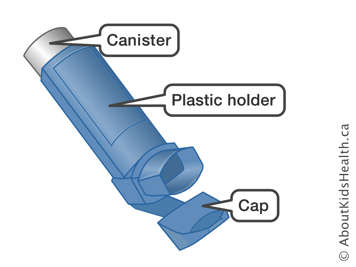
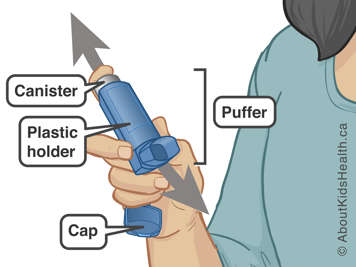
given using a metered-dose inhaler (MDI). An MDI is made up of a metal
canister inserted into a plastic holder. The metal canister contains the
asthma medicine. When the canister is pushed down, it sprays a puff of
medicine out. Young children cannot use an MDI properly by themselves.
You will need to help your child.
Spacer with mask
Στα παιδιά
χρησιμοποιούνται οι αεροθάλαμοι, που είναι πλαστικές συσκευές με μάσκα ή
επιστόμιο στο ένα άκρο τους και υποδοχή για της συσκευή εισπνοή στο άλλο.
Οι αεροθάλαμοι
Κάνουν
αποτελεσματικότερη τη χορήγηση των εισπνεόμενων φαρμάκων.
Μειώνουν
την εναπόθεση του φαρμάκου στο στοματοφάρυγγα και την απορρόφησή του από
τη συστηματική κυκλοφορία.
Βρέφη και
παιδιά προσχολικής ηλικίας πρέπει να χρησιμοποιούν συσκευή αερολυμάτων με
αεροθάλαμο με μάσκα.
Παιδιά
σχολικής ηλικίας πρέπει να χρησιμοποιούν
αεροθάλαμο με επιστόμιο.
Παιδιά
μεγαλύτερα των 8-10 ετών που έχουν πρόβλημα συγχρονισμού πρέπει να
χρησιμοποιούν αεροθάλαμο.
Παιδιά
κάθε ηλικίας κατά τη διάρκεια ασθματικού παροξυσμού.
Παιδιά κάθε ηλικίας που λαμβάνουν μεγάλες δόσεις
εισπνεόμενων κορτικοστερειδών
Οδηγίες
χρήσης:
Η συσκευή
εισπνοών σε αντίθεση με τους ενήλικες, θα πρέπει να χρησιμοποιείται με
αεροθάλαμο, ώστε να αυξάνεται η εναπόθεση του φαρμάκου στους πνεύμονες και
να μειώνεται η εναπόθεση του στο στοματοφάρυγγα. Αυτό ισχύει για όλα τα
παιδιά έως 8 ετών, ανεξάρτητα απο την ικανότητα τους να χρησιμοποιούν τη
συσκευή.
Αφαιρούμε
το καπάκι απο την συσκευή εισπνοών και ανακινούμε πάντα καλά.
Ψεκάζουμε
δοκιμαστικά κάτω και βεβαιωνόμαστε ότι αποδεσμεύεται φάρμακο.
Εφαρμόζουμε
τη συσκευή στον αεροθάλαμο.
Εφαρμόζουμε
τη μάσκα στο στόμα του παιδιού με τρόπο που να καλύπτει το στόμα και τη
μύτη. Είναι πολύ σημαντικό η εφαρμογή να είναι πολύ καλή ώστε να μην
υπάρχουν απώλειες.
Πιέζουμε
τη συσκευή μια φορά και μετράμε αργά μέχρι το 10. Καθ’ όλη τη διάρκεια
διατηρούμε τη μάσκα σε επαφή με το στόμα του παιδιού, δεν τη μετακινούμε.
Επαναλαμβάνουμε
εάν το παιδί χρειάζεται περισσότερες απο μια εισπνοές.
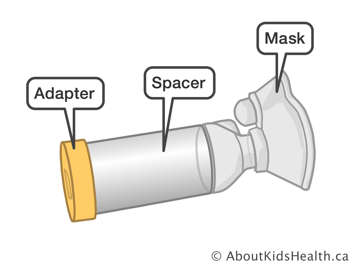
What is a spacer?
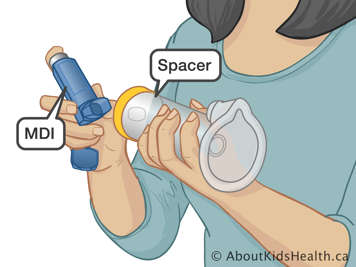
A spacer, also called an aerosol-holding
chamber, is a device that attaches to the MDI. It slows down the
medicine delivered and allows your child to breathe it directly into
their lungs. Without a spacer, the medicine would spray into your
child’s mouth and throat, with less of it reaching the lungs.
AeroChamber® and OptiChamber® are examples of spacers.
You should always use a spacer when giving your child their MDI asthma medicine.
Each child should have their own spacer. Do not share spacers with other children.
Spacers can be used with a mouthpiece or a mask
Depending
on your child, you may give their asthma medicine using a spacer with a
mouthpiece or with a mask. Younger children need to use a spacer with a
mask until they can follow instructions to seal their lips together
when using a mouthpiece and are able to hold their breath when the
medication is administered. If your child is able to effectively use a
mouthpiece, they can switch over to a spacer with a mouthpiece. However,
when some children are very unwell, they may find it difficult to use
the mouthpiece and may receive their asthma medication using a spacer
with a mask.
Helping your child
How to use a spacer
Watch the video below to give your child asthma medicine using a spacer.
How to take your puffer with a mouthpiece spacer
Watch the video below to recognize the sound of using a spacer incorrectly.
Puffer + mouthpiece spacer - making the wrong sound
How to use a spacer with a mask
Watch the video or follow the illustrated steps below to give your child asthma medicine using a spacer with a mask.
How to take your puffer with a spacer and mask
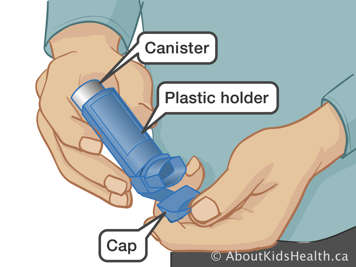
Gather the MDI and spacer
Gather the spacer and the MDI.
Insert the canister into the plastic holder if they are not already put together.
Take the plastic cap off the MDI.
Prepare the MDI
With the plastic cap off, shake the MDI five times.
Connect the MDI and spacer
Put the MDI upright into the rubber hole of the spacer. The MDI should fit tightly into the hole.
Prepare your child by having them sit up or stand in a comfortable position.
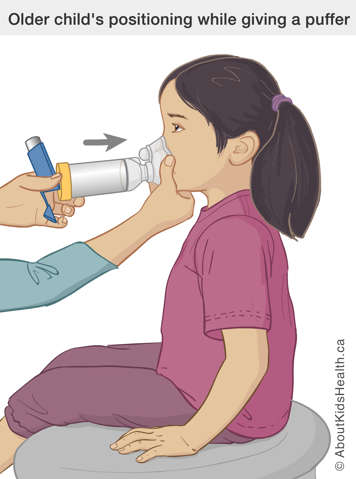
Hold the mask to your child’s face
Older children can sit or stand in a comfortable position to receive their medication.
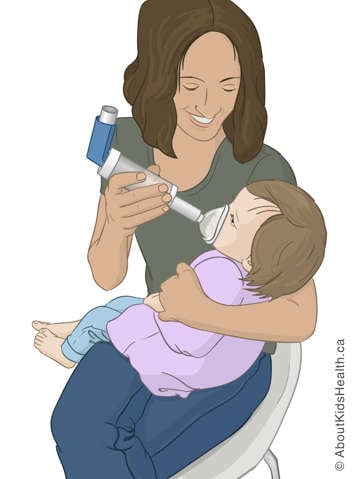
Younger children should be held on a parent’s lap. You can use the
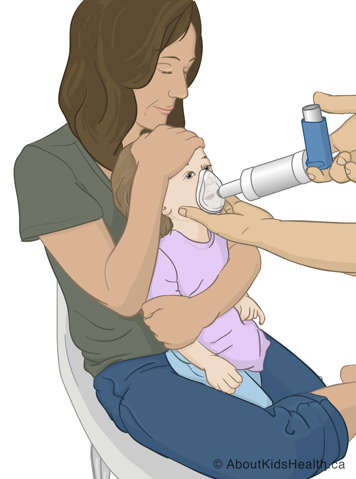
“one-person approach” or “two-person approach” to give medicine to a
younger child.
One-person approach
Sit in a chair and place your
child on your lap. Hug the child tightly with one arm and, with your
other hand, press the top of the puffer firmly to release a puff of
medicine.Two-person approach
Cross your leg over your child’s
legs, hold their arms with your own arm and hold their forehead against
your chest. Another adult will hold your child’s chin, place the mask
firmly over your child’s nose and mouth, and press the top of the puffer
firmly to release a puff of medicine.
Give the medicine
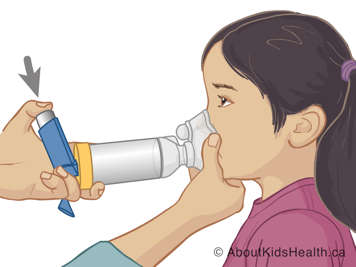
Hold the mask over your child’s face with one hand. Hold the spacer
with the other hand and press the MDI down firmly with your thumb. This
will release one puff into the spacer.
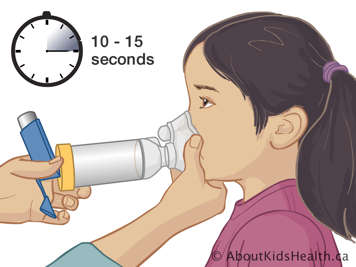
Hold the mask over your child’s nose and mouth for 10 to 15 seconds.
This should allow your child to take about six breaths. You can also
watch a valve move inside the spacer to count the breaths. Make sure
your child takes deep breaths.
If your child needs to take more than one puff of the medicine, remove the MDI from the spacer and repeat steps 2 to 5.
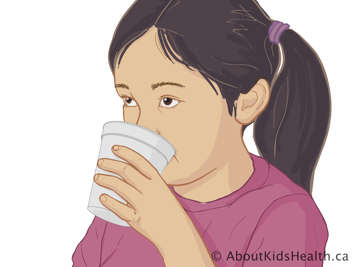
Have your child rinse their mouth
Take the mask off your child’s face.
Wipe your child’s face. Let your child drink or rinse their mouth
with water afterwards. This will help remove any medicine left in the
mouth.
How to care for your child’s metered-dose inhaler
Your child's MDI and spacer need proper care and cleaning in order to
dispense medicine effectively. This is a simple process that involves a
few steps.
Make sure the cap is on the MDI when your child is not using it.
Make sure the hole where the medicine comes out is not plugged. Use a
dry cloth or tissue to wipe off any powder around the hole or in it.
Store the MDI at room temperature. Do not let it get cold or hot. If it gets cold, warm it to room temperature with your hands.
Always check the expiry date of the MDI before use.
Write on the metal canister the date when the MDI is first used.
Your child’s MDI contains only a certain number of medication doses
(puffs). It is difficult to tell when an MDI is empty by feel or sound
alone. You can keep track of the number of doses remaining in your
child’s MDI by using a counter tool. This will help you know when your child’s medication is running low and needs to be replaced.
How to care for your child’s spacer
Washing your child’s spacer is very simple. Try to do it before using it for the first time, and then every week after that.
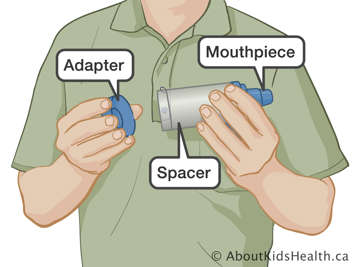
Take the MDI adapter (the rubber back piece that lets the MDI fit in) off the spacer. Do not take off the mask or mouthpiece.
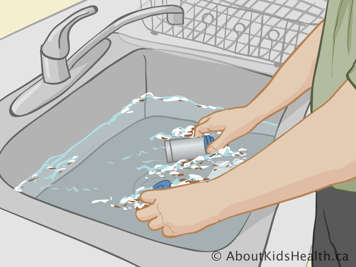
Soak the adapter and the spacer in lukewarm water with mild dish detergent.
Gently shake both parts so soapy water can get into all the parts.
Rinse both parts in clean water.
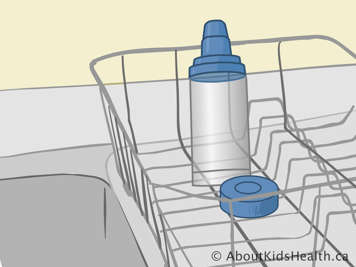
Shake off excess water. Do not use a towel.
Stand the spacer up in an upright position and let it air dry.
Put the adapter back onto the spacer when both parts are completely dry.
Do not wash your child’s spacer in a dishwasher.
Most spacers last about a year before you need to replace them. Ask
your child’s health-care provider for a spacer prescription when it is
time to replace your child’s spacer.
If you think there might be a problem with your child’s spacer, or if
you have been using it for one year, have a health-care provider check
it. They can tell you if the spacer is working properly.
Ως εξάρθρημα ώμου ορίζεται η απομάκρυνση της αρθρικής επιφάνειας του βραχιονίου οστού (κεφαλή) από την αρθρική επιφάνεια της ωμοπλάτης (ωμογλήνη). Αν και στην πλειοψηφία των περιστατικών, το εξάρθρημα οφείλεται σε τραυματικό γεγονός που απαιτεί αρκετή βία, ορισμένες φορές προκαλείται εξαιτίας των χαλαρών αρθρώσεων του ασθενούς.
Οι συνέπειες αυτού είναι ο τραυματισμός του επιχείλιου χόνδρου της ωμογλήνης (βλάβη Bankart), της κεφαλής του βραχιονίου (βλάβη Hill-Sachs), των θυλακοσυνδεσμικών στοιχείων, του αρθρικού χόνδρου, των νεύρων και των οστών της περιοχής.
Υπάρχουν διαφορετικού τύπου εξαρθρήματα ώμου;
Το εξάρθρημα ώμου μπορεί να είναι:
– πρόσθιο, που συναντάται στο 96-98% των περιπτώσεων,
– οπίσθιο που παρατηρείται σπάνια, σε λιγότερο από 4% των περιπτώσεων,
– κατώτερο που είναι εξαιρετικά σπάνιο.
Ποια είναι τα συμπτώματατου εξαρθρήματος του ώμου;
Μερικά από τα συμπτώματα που υποδηλώνουν πως έχετε υποστεί εξάρθρημα ώμου, είναι:
– οξύς πόνος
– αδυναμία κίνησης της άρθρωσης
– παραμόρφωση της άρθρωσης
– πρήξιμο ή/και αιμάτωμα στην περιοχή
– μούδιασμα στον ώμο ή στο χέρι
Ποιες είναι οι αιτίες που προκαλούν το εξάρθρημα του ώμου;
Τα αίτια που προκαλούν ένα εξάρθρημα ώμου ποικίλλουν, κυρίως εξαιτίας των ανατομικών στοιχείων της άρθρωσης, που επιτρέπει την εκτέλεση μεγάλου εύρους κινήσεων.
Ως συνηθέστερα αίτια αναφέρονται οι:
– Αθλητικοί τραυματισμοί: Αφορούν αθλήματα κατά τα οποία υπάρχει σωματική επαφή, όπως το ποδόσφαιρο, το χάντμπολ, η καλαθοσφαίριση, καθώς και άλλα στα οποία σημειώνονται πτώσεις, όπως το βόλεϊ.
– Δυνατοί τραυματισμοί από πτώση, εκτός αθλητικής δραστηριότητας, όπως για παράδειγμα εξαιτίας ενός τροχαίου ατυχήματος ή λόγω πτώσης από σκάλα.